
Research Facilities
The Facilities include
Laboratories
The Department of ECE is equipped with various software some of them are beyond curriculum to enhance students and faculty knowledge in signal processing, analog and digital design, antenna design ,microprocessor & microcontroller, IOT product development.
| S. No. | Name of the Software | Name of the Laboratory | No of User’s |
|---|---|---|---|
| 1 | MAT LAB Software | BS / DSP | Campus Wide |
| 2 | Keysight ADS Software | HFSS | 05 |
| 3 | Ansys Academic Teaching Bundle Software | HFSS | 25 |
| 4 | Keil Software | MPMC | 25 |
| 5 | MASM Software | MPMC | 25 |
| 6 | Multisim Software Licensed Version (V14.0) | ECA | 25 |
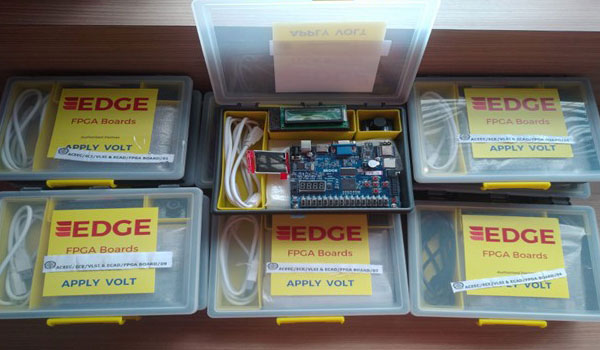
| 7 | XILINX Vivado V15.0.1 Software | VLSI | 25 |
Simulation and Modeling Tools _Testing and experimental facilities
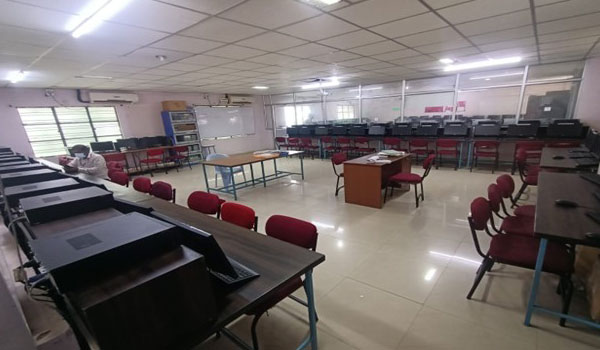
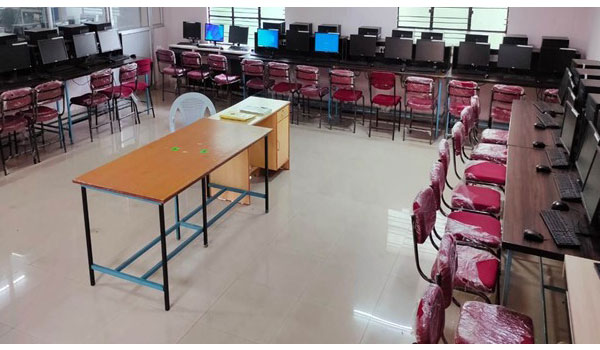
Centre for VLSI
Training Students in Latest Technologies for Chip Development using XILINX and Microwind Tools.
| Physical Laboratory Name | VLSI LAB (1206A) |
| % Utility | 100% |
| Seating Capacity per session | 33 |
| Area ( in SQM) | 77.4 |
| Lighting | Excellent (4 windows) |
| Provisions provided to use Teaching-Aids | LCD projector, laptop, white board |
| Work Tables with Chairs | 35 std chairs& Chairs (for faculty) |
| Batch Size | 30 |
| Storage Facility | 1 Almirah |
| Notice Boards | yes |
| Furniture Details | Chairs, lights, Tables, Fire Extinguisher |
| Stock Registers | yes |

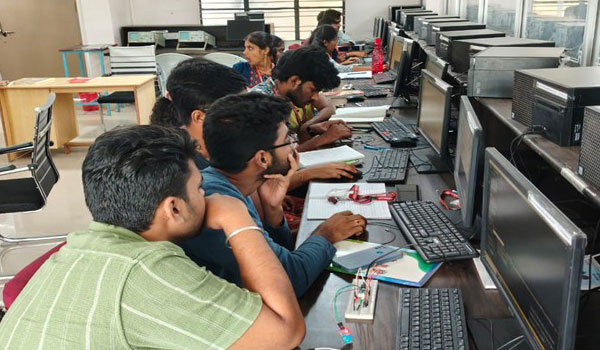
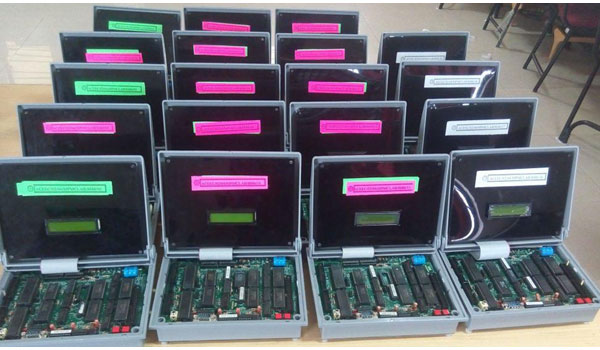
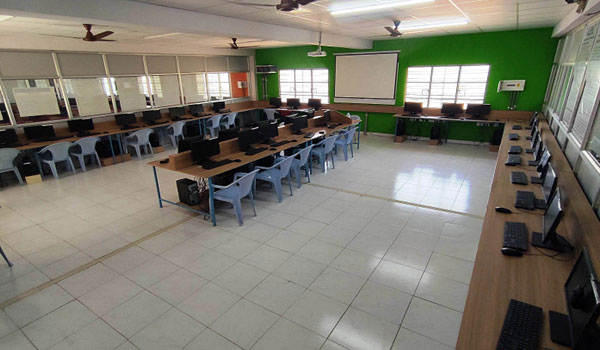
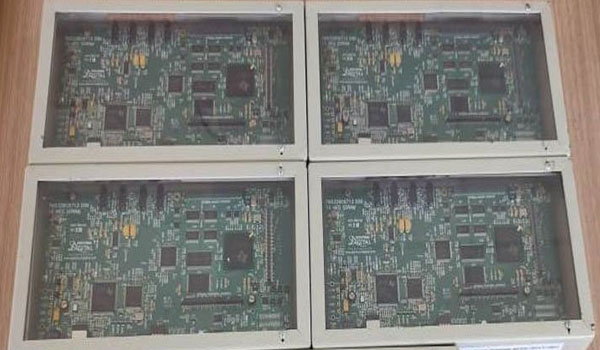
Microprocessor & Microcontroller Lab
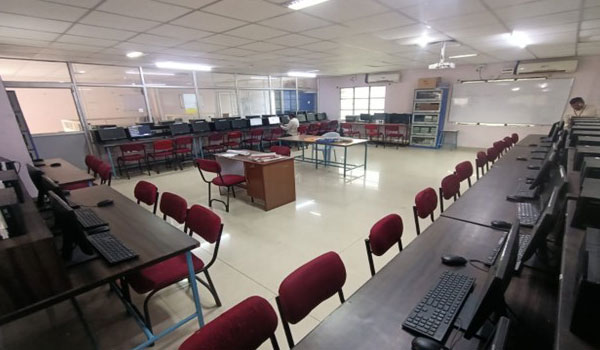
| Physical Laboratory Name | Microprocessor & Microcontroller Lab |
|---|---|
| % Utility | 100% |
| Seating Capacity per session | 33 |
| Area ( in SQM) | 77.4 |
| Lighting | Excellent (4 windows) |
| Provisions provided to use Teaching-Aids | LCD projector, laptop, white board |
| Work Tables with Chairs | 35 std chairs& Chairs (for faculty) |
| Batch Size | 30 |
| Storage Facility | 1 Almirah |
| Notice Boards | yes |
| Furniture Details | Chairs, lights, Tables, Fire Extinguisher |
| Stock Registers | yes |
DEPARTMENT OF CSE (ARTIFICIAL INTELLIGENCE AND MACHINE LEARNING)
The following is the list of research facilities available in CSE(AI&ML) department.
Laboratories
The department maintains well-equipped laboratories to support teaching, research, and project-based learning in AI, ML, and Data Science domains.
Software:
The laboratories are equipped with the following software and development environments:
- Programming and Analysis Tools: Python, R, Anaconda, (for managing Python environments and packages), WEKA.
- AI/ML Frameworks: TensorFlow, PyTorch, Keras (for building and training machine learning models).
- Libraries for ML and NLP: Scikit-learn (machine learning), OpenCV (computer vision), NLTK, spaCy (natural language processing), Pandas, NumPy, Matplotlib, Seaborn, Plotly.
- Development Environments: Jupyter Notebook / JupyterLab (interactive computing and data visualization), Visual Studio Code (VS Code), Anaconda Navigator, Rstudio, Google Colab, Eclipse, Android Studio.
- Web and Mobile Development Tools: Node.js (for backend and server-side programming), Flutter (for cross-platform mobile app development), Flask, HTML5, CSS3, and JavaScript.
- Database Tools: MySQL
- Virtualization and Containerization Tools: Docker, Jenkins, and Kubernetes (for automation, continuous integration/continuous deployment (CI/CD), and containerized application development), Minikube.
- Version Control and Collaboration Tools: Git, GitHub and GitLab (for version control, collaborative development, and project management), Bitbucket.
Libraries
The department provides access to both print and digital resources to support faculty and student research activities.
Digital Research Libraries:
- IEEE Xplore: Access to papers on AI, machine learning, and computer science
Print Journals
- International Journal of Artificial Intelligence and Computational Research(IJAICR)
- International Journal of Embedded Systems and Computer Engineering
- International Journal of Artificial Intelligence and Machine Learning(IJAIML)
National Journals
- Journal on Embedded Systems
- ICTACT Journal on Communication Technologies
- ICTACT Journal on Soft Computing
- ICTACT Journal on Management Studies
- Journal on Artificial Intelligence & Machine Learning
- Inventi Impact: Artificial Intelligence
- Journal on Augmented & Virtual Reality
- Inventi Impact:Digital Multimedia Broadcasting
- Journal of Hybrid Computing Research
Data Centres
The department utilizes modern cloud-based data centers for AI and ML research
- Access to cloud computing platforms such as Amazon Web Services (AWS) and Google Cloud Platform (GCP) for large-scale data processing, model training, and deployment.
Computing infrastructure (e.g., high-performance computing, cloud computing)
The department provides robust computing infrastructure to facilitate advanced research and practical experimentation.
High-Performance Computing (HPC) Facility: GPU-based computing systems are available for deep learning model training, data-intensive analysis, and simulation research.
Simulation and modelling tools
The Department of Computer Science and Engineering (AI & ML) provides access to a range of simulation and modeling tools that enable students and researchers to design, test, and analyze artificial intelligence and machine learning models in virtual environments.
Google Colab: A cloud-based simulation environment supporting GPU execution for training and testing AI models.
Anaconda and Jupyter Notebook: Provide an integrated platform for data simulation, analysis, and interactive visualization.
Testing and experimentation facilities (e.g., wind tunnels, climate chambers)
The department encourages experimental research and prototype development through dedicated facilities.
Software Testing Environments: Tools for unit testing, integration testing, and automated GUI testing (Selenium, Postman, JMeter).
DevOps Testing Pipelines: Integration with Jenkins, Docker, and GitLab CI for automated build, test, and deployment processes.
DEPARTMENT OF CSE(IoT)
The following is the list of research facilities available in CSE(IoT) Department.
Laboratories
The department maintains well-equipped laboratories to support teaching, research, and project-based learning in CSE(IoT) All Domains.
Software:
The laboratories are equipped with the following software and development environments:
- Raspberry Pi, Arduino, and cloud computing platforms: individuals can acquire hands-on experience while also developing their skills in prototyping, data analysis, and system integration.
- Operating Systems: windows11, ubuntu 22.04LTS.
- Programming and Analysis Tools: Python, R, Anaconda,Jypyter Notebook, GCC,G++ Compilers,JDK.
- Computer Vision: TensorFlow,OpenCV
- AI Frameworks: TensorFlow, PyTorch, Keras (for building and training machine learning models).
- Libraries for ML and NLP: Scikit-learn (machine learning), OpenCV (computer vision), NLTK, spaCy (natural language processing), Pandas, NumPy, Matplotlib, Seaborn, Plotly.
- Development Environments:, Visual Studio Code (VS Code), Anaconda Navigator, Rstudio, Google Colab, Eclipse, Android Studio.
- Web and Mobile Development Tools: Node.js (for backend and server-side programming), Flutter (for cross-platform mobile app development), Flask, HTML5, CSS3, and JavaScript.
- Database Tools: MySQL
- Virtualization and Containerization Tools: Docker, Jenkins, and Kubernetes (for automation, continuous integration/continuous deployment (CI/CD), and containerized application development), Minikube.Power BI.
- Version Control and Collaboration Tools: Git, GitHub and GitLab (for version control, collaborative development, and project management), Bitbucket.
- Networking: Wireshark, Nmap, ns2, Nam, Cisco packet Tracer.
- Quantum Computing: qiskit
Hardware:
- Sensors and development boards that allow students to build and test their own IoT Solutions
- Raspberry Pi Boards, Arduino Boards, ESP8266 wifi module, Node MCU board and so on
- Modern DELL Optiplex Tower Plus 7010, Vostro 3888 and 3910 systems with 12th and 13th Gen Intel processors support advanced computational research.
- ASRock GPU workstation (16 GB RAM, i5 7th Gen) suitable for graphics-intensive or simulation-based research.
- Older systems (HP 280 G3, Lenovo 10HLA01FIH) can be used for lightweight applications, documentation, and network-based tasks.
- All systems are equipped with large-capacity HDDs , providing ample storage for datasets and research materials.
- In addition to the physical facilities, CSE(IoT) Dept also provides access to online resources and platforms that enhance students’ learning experience.
- We have subscriptions to leading academic journals, e-books, and online courses, giving students access to a vast pool of knowledge and research materials.
- By utilizing these state-of-the-art facilities and resources, students are able to explore the unlimited possibilities of IoT technology and push the boundaries of innovation.
Department of Civil Engineering
Introduction
The Department of Civil Engineering at ACE Engineering College, Hyderabad, is committed to fostering innovation and academic excellence in the field of Water Resources Engineering. With a focus on sustainable water management, environmental protection, and infrastructure development, the department is equipped with a wide range of research facilities that support both theoretical learning and practical application. This report outlines the key research infrastructure available, including laboratories, computing resources, simulation tools, libraries, and testing facilities.
Laboratories
The department maintains a comprehensive set of laboratories that facilitate hands-on training, experimental research, and prototype testing related to water resources:
- Fluid Mechanics & Hydraulic Machinery Laboratory Equipped with flumes, notches, turbines, pumps, and flow measuring devices. This lab enables students to study flow dynamics, energy losses, hydraulic gradients, and pump performance.
- Environmental Engineering Laboratory Supports the analysis of water quality, wastewater treatment processes, and environmental impact studies. Includes pH meters, turbidity meters, BOD/COD testing kits, and filtration units.
- Surveying and Geomatics Laboratory Provides equipment such as total stations, GPS devices, and digital theodolites for field-level data collection, crucial for hydrological modeling and watershed studies.
- Geotechnical Engineering Laboratory Supports groundwater-related studies by allowing tests on soil permeability, porosity, and water retention characteristics.
These laboratories serve as a vital foundation for both undergraduate learning and faculty/student-led research projects.
Library and Knowledge Resources
The Central Library and Departmental Library provide extensive academic support for Water Resources Engineering through:
- A wide collection of textbooks, IS codes, handbooks, and design manuals.
- Subscriptions to reputed journals, periodicals, and online databases (e.g., DELNET, NPTEL, IEEE Xplore).
- Access to previous project reports, theses, and case studies on topics related to hydrology, hydraulics, and environmental systems.
- E-learning platforms that include video lectures and tutorials relevant to civil and water resources engineering.
These resources play a key role in supporting literature reviews, design referencing, and theoretical understanding.
Computing Infrastructure and Software Tools
The department is equipped with dedicated computer labs and smart classrooms, offering high-speed internet and licensed software essential for research in water resources.
Available Software Tools:
- QGIS – for spatial analysis, watershed delineation, and land-use mapping.
- HEC-RAS – for river modeling, floodplain mapping, and hydraulic structure simulation.
- EPANET – for water distribution network design and pressure analysis.
- EPA SWMM – for stormwater runoff modeling and urban drainage design.
Additional Infrastructure:
- Wi-Fi-enabled campus with internet access for students and researchers.
- Systems equipped for running simulation models and data visualization.
- Interactive whiteboards and projectors for model demonstration and analysis.
This computational infrastructure enables students to undertake realistic design projects, policy simulations, and decision-support analysis.
Simulation and Modeling Tools
Advanced simulation and modeling play a crucial role in solving real-world water resource challenges. The department integrates software tools and models to support:
- Watershed Hydrology – using QGIS and HEC-HMS (when available).
- River Flow and Flood Analysis – using HEC-RAS for 1D/2D simulations.
- Stormwater Management – using EPA SWMM for urban flooding scenarios.
- Water Supply Network Modeling – using EPANET to simulate pressure, flow, and network optimization.
Projects often involve integrating GIS data, rainfall records, and field measurements with model outputs to inform design decisions and develop mitigation strategies.
Testing and Experimental Facilities
ACE Engineering College offers facilities for both indoor testing and field-level experimentation, critical for validating theoretical models and ensuring practical relevance.
- Hydraulic Equipment Testing – to assess pump and turbine performance under varying flow conditions.
- Environmental Testing – for analyzing pollutant levels, treatment efficiency, and water quality parameters.
- Surveying Equipment – supports field surveys for topographical and hydrological data acquisition.
- Material Testing Labs – although primarily for structural engineering, they assist in analyzing interactions between water and construction materials, such as permeability and erosion resistance.
In addition, the department engages in consultancy services involving water and environmental testing, which enhances real-world exposure and research relevance.
Field Work and Project Support
The department actively encourages project-based learning and field surveys, including:
- Watershed mapping and stream flow monitoring
- Rainwater harvesting design and implementation
- Groundwater recharge studies
- Infrastructure assessment for water supply and drainage
These activities are often supported by the college’s institutional resources, faculty guidance, and collaborations with local agencies or industries.
DEPARTMENT OF INFORMATION TECHNOLOGY
Laboratories:
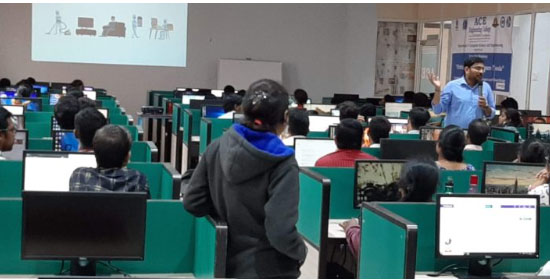
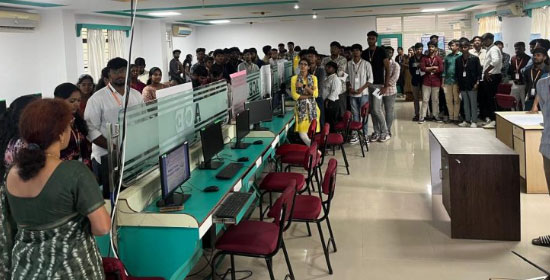
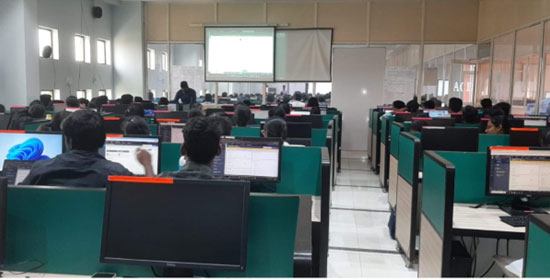
Our Department has 6 Laboratories:
Each Lab is well equipped with
- Smart Board
- White Board
- LCD Projector
- 6/7 KVA Delta UPS
- 50 W AHUJA Portable Speaker
All the Labs are equipped with DELL Desktops with good Internet Connectivity and Latest Software
Systems Configuration:
Dell Optiplex 7010 Tower Desktops
- I7 Processor
- 16 GB Ram
- 512 GB SSD Hard Disk
- 20’’ LCD Monitor
Dell Vastro 3910 Desktops
- 8 GB RAM
- 1TB HDD
- I3 Processor
- 18’’ LCD monitor
Dell Vastro 3888 Desktops
- 8 GB RAM
- 1TB HDD
- I3 Processor
- 18’’ LCD monitor
Dell Optiplex Desktops
- 4 GB RAM
- 500 GB HDD
- I3 Processor
- 18’’ LCD monitor



Libraries: Nil
Data centers: Nil
Computing infrastructure (e.g., high-performance computing, cloud computing): Nil
Simulation and modeling tools: Nil
Testing and experimentation facilities (e.g., wind tunnels, climate chambers): Nil
Department of Electrical and Electronics Engineering
| S.No. | Facility | Current Status / Description | Requirements / Recommendations |
|---|---|---|---|
| 1 | Research Laboratories |
The department currently has the following laboratories: Electrical Machines Lab Power Systems Lab Power Electronics Lab Basic Electrical Engineering (BEE) Lab Simulation Lab Control Systems Lab |
Establish new laboratories to strengthen research activities, such as: Electric Vehicle (EV) Lab Renewable Energy Lab Smart Grid and Microgrid Lab Energy Storage and Power Quality Lab. These labs will support experimental validation of renewable, grid-interactive, and power electronic systems. |
| 2 | Library | Currently, the EEE Department does not have a departmental library for research purposes. |
Establish a Dedicated Departmental Library. Maintain Google-quality reference books, IEEE and Springer research journals, and conference proceedings. - Provide access to online databases like IEEE Xplore, Science Direct, and Scopus. - Include e-resources and research thesis repository for scholars. |
| 3 | Computing Infrastructure |
Existing systems: Intel(R) Core(TM) i3- 4170 CPU @ 3.60GHz (3.60 GHz), 64-bit Operating System. |
Require high-configuration systems for advanced simulations and research work. Recommended Configuration: Intel(R) Core(TM) i9 Processor / AMD Ryzen 9 32–64 GB RAM 1 TB SSD + 2 TB HDD NVIDIA RTX GPU (8–12 GB VRAM) Dual monitor setup High-speed LAN and Wi-Fi connectivity |
| 4 | Software Tools | Currently using MATLAB for simulation and modeling. |
Additional software required for enhanced research: dSPACE – Hardware-in-the-loop (HIL) testing PSCAD / EMTDC – Power system transient analysis ETAP – Load flow, protection, and short circuit studies PLECS – Power electronics simulation LabVIEW – Data acquisition and control HOMER / PVsyst – Renewable energy system design and analysis Ansys Maxwell / COMSOL – Electromagnetic field analysis |
| 5 | Testing and Experimental Facilities | No dedicated testing and experimental facilities are available for hardware validation. | Establish facilities for hardware testing, power quality assessment, and prototype development. - Equip with oscilloscopes, power analyzers, harmonic analyzers, grid simulators, and data acquisition systems. - Develop Hardware-in-Loop (HIL) and Real- Time Simulation (RTDS) setups for experimental validation of research models. |
| 6 | Existing Renewable Energy Setup |
Solar Power Plant: Total installed capacity – 114 kW. 10 kW (Off-grid) – Mallikarjuna Block (Block-A) 104 kW (On-grid) – Seshasai Block (Block-B) Fully maintained by the EEE Department. 225 kW (On grid) on the rooftop of Block B |
Utilize this solar power plant for real-time performance monitoring and analysis. Integrate the plant data with simulation and testing facilities for research validation and student projects. |
Note:
Contingency Facilities for Researchers
To promote quality research and ensure uninterrupted academic activities, the college needs to provide adequate contingency facilities for researchers of the Electrical and Electronics Engineering Department. These facilities are essential to handle unforeseen requirements, equipment maintenance, and day-to-day research support.
Department of CSE (Data Science)
The following is the list of research facilities available in CSE(Data Science) department.
1.Laboratories
The CSE(Data Science) department has well-equipped laboratories to support teaching, research, and project-based learning in Data Science, AI& ML domain and Mathematical Laboratory.
Software:
The laboratories are equipped with the following software and development environments:
- Programming and Analysis Tools: Python, R, Anaconda, (for managing Python environments and packages), C, Java, Ruby, Perl, TCL
- Web and Mobile Development Tools: Node.js (for backend and server-side programming), Flutter (for cross-platform mobile app development), Flask, HTML5, CSS3, and JavaScript.
- AI/ML Frameworks: TensorFlow, PyTorch, Keras (for building and training machine learning models).
- Libraries for ML and NLP: Scikit-learn (machine learning), OpenCV (computer vision), NLTK, spaCy (natural language processing), Pandas, NumPy, Matplotlib, Seaborn, Plotly.
- Database Tools: MySQL, Mongo-DB
- Development Environments: Jupyter Notebook / JupyterLab (interactive computing and data visualization), Visual Studio Code (VS Code), Anaconda Navigator, Rstudio, Google Colab, Eclipse, Android Studio, Dart, Flutter, Docker, Apache Kafka, ZooKeeper
- Visualization Tools: Power BI, R
- Version Control and Collaboration Tools: Git, GitHub and GitLab (for version control, collaborative development, and project management)
- Network Tools: Nmap, wireshark, NS2 Simulator
- Big Data Analytical Tools: Hadoop-PIG, HIVE
2. Libraries
The department maintains library and provide access to all the students, staff and research scholars for reference books, research papers and digital resources .
Digital Research Libraries:
- IEEE Xplore: Access to papers on AI, machine learning, and computer science
Print Journals
- International Journal of Artificial Intelligence and Computational Research(IJAICR)
- International Journal of Embedded Systems and Computer Engineering
- International Journal of Artificial Intelligence and Machine Learning(IJAIML)
National Journals
- Journal on Embedded Systems
- ICTACT Journal on Communication Technologies
- ICTACT Journal on Soft Computing
- ICTACT Journal on Management Studies
- Journal on Artificial Intelligence & Machine Learning
- Inventi Impact: Artificial Intelligence
- Journal on Augmented & Virtual Reality
- Inventi Impact:Digital Multimedia Broadcasting
- Journal of Hybrid Computing Research
3. Data Centres
The department is providing storage, computing, and networking resources specifically for data analytics, machine learning, artificial intelligence, and research purposes.
- Access to cloud computing platforms such as Google Cloud Platform (GCP) for large-scale data processing, model training, and deployment and Amazon Web Services (AWS)
4. Computing infrastructure (e.g., high-performance computing, cloud computing)
The department provides robust computing infrastructure to facilitate advanced research and practical experimentation.
- High-Performance Computing (HPC) Facility: GPU-based computing systems are available for deep learning model training, data-intensive analysis, and simulation research.
- All labs are equipped with Dell Systems (i7 processor, 16GB RAM,1 TB SSD, 11 gen)
- All Classrooms are installed with Digital Smart Board (Interactive Digital Display, 100-inch, 4K UHD, Touchscreen with Stylus Support)
- Department is providing free Wifi for staff and students.
5. Simulation and modelling tools
The Department of Computer Science and Engineering (Data Science) provides access to a range of simulation and modeling tools that enable students and researchers to design, test, and analyze artificial intelligence and machine learning models in virtual environments.
Google Colab: A cloud-based simulation environment supporting GPU execution for training and testing AI models.
Simulation Tools: Nmap, Wireshark and NS2 simulator.
Modelling Tools: TensorFlow, Pytorch, matplotlib, Scikit-learn and R.
6. Testing and experimentation facilities (e.g., wind tunnels, climate chambers)
The department encourages experimental research and prototype development through dedicated facilities. Labs are equippped with Clustered servers and GPUs for Running large-scale simulations, ML training, and big data analytics
Software Testing Environments: Tools for unit testing, integration testing, and automated GUI testing (Selenium)
DevOps Testing Pipelines: Integration with Jenkins and Docker
DEPARTMENT OF COMPUTER SCIENCE AND ENGINEERING
The following is the list of research facilities available in CSE Department.
1. Laboratories
The department maintains well-equipped laboratories to support teaching, research, and project-based learning in CSE All Domains.
Software:
The laboratories are equipped with the following software and development environments:
- Operating Systems: windows11, ubuntu 22.04LTS.
- Programming and Analysis Tools: Python, R, Anaconda,Jypyter Notebook, GCC,G++ Compilers,JDK.
- AI Frameworks: TensorFlow, PyTorch, Keras (for building and training machine learning models).
- Libraries for ML and NLP: Scikit-learn (machine learning), OpenCV (computer vision), NLTK, spaCy (natural language processing), Pandas, NumPy, Matplotlib, Seaborn, Plotly.
- Development Environments:, Visual Studio Code (VS Code), Anaconda Navigator, Rstudio, Google Colab, Eclipse, Android Studio.
- Web and Mobile Development Tools: Node.js (for backend and server-side programming), Flutter (for cross-platform mobile app development), Flask, HTML5, CSS3, and JavaScript.
- Database Tools: MySQL
- Virtualization and Containerization Tools: Docker, Jenkins, and Kubernetes (for automation, continuous integration/continuous deployment (CI/CD), and containerized application development), Minikube.Power BI.
- Version Control and Collaboration Tools: Git, GitHub and GitLab (for version control, collaborative development, and project management), Bitbucket.
- Networking:Wireshark,Nmap,ns2,nam,cisco packet Tracer.
Hardware:
- Modern DELL Optiplex Tower Plus 7010, Vostro 3888 and 3910 systems with 12th and 13th Gen Intel processors support advanced computational research.
- ASRock GPU workstation (16 GB RAM, i5 7th Gen) suitable for graphics-intensive or simulation-based research.
- Older systems (HP 280 G3, Lenovo 10HLA01FIH) can be used for lightweight applications, documentation, and network-based tasks.
- All systems are equipped with large-capacity HDDs (up to 1 TB), providing ample storage for datasets and research materials.
DEPARTMENT OF MECHANICAL ENGINEERING
1. Introduction
The Department of Mechanical Engineering at ACE Engineering College is dedicated to promoting innovation, practical skill development, and research excellence. With a curriculum that integrates theory, hands-on laboratory experience, and cutting-edge simulation tools, the department prepares students to address real-world engineering challenges.
The department offers a robust research and project ecosystem through its laboratories, computing resources, fabrication facilities, and design tools. These facilities support academic coursework, final-year projects, and advanced research in areas such as design, manufacturing, materials testing, and thermal systems.
2. Laboratories
The Mechanical Engineering Department maintains a comprehensive set of laboratories aligned with curriculum and research requirements. Labs are scheduled for regular coursework and remain accessible beyond class hours for project work and research.
Key Features of Laboratory Infrastructure:
- Laboratories available throughout the academic year based on the timetable.
- Fully equipped with machines, instruments, computers, and licensed software as per curriculum.
- Dedicated CAD/CAM labs with high-speed internet connectivity.
- Labs remain open until late evening to encourage practice and project development.
- Project Lab available exclusively for student innovations, prototyping, and fabrication.
Major Laboratories:
- CAD & CAM Laboratory
- Production Technology Laboratory
- Machine Tools Laboratory
- Mechanics of Solids Laboratory
- Kinematics of Machines Laboratory
3. Library and Knowledge Resources
The department leverages both Central Library and Departmental Library resources to support learning and research in mechanical engineering.
Available Resources:
- A large collection of textbooks, handbooks, IS codes, machine design data books, and reference manuals.
- Subscriptions to leading journals, technical magazines, and online databases (e.g.,NPTEL).
- Access to past project reports, technical papers, and case studies in manufacturing, design, and thermal systems.
- Digital learning platforms and e-resources to supplement classroom learning.
These resources help students with design reference, material selection, analysis methods, and project documentation.
4. Computing Infrastructure and Software Tools
The department provides advanced computing infrastructure to support design, analysis, and manufacturing simulation.
Available Tools and Facilities:
- CAD Tools: CREO for 3D modeling and product design.
- CAE Tools: ANSYS for Finite Element Analysis (FEA), stress analysis, and thermal simulation.
- CAM Tools: CNC programming and simulation software for part manufacturing.
- High-speed internet and Wi-Fi connectivity for students and researchers.
- Smart classrooms with interactive whiteboards and projectors for demonstration and analysis.
This infrastructure supports students in concept-to-prototype workflows involving design, simulation, optimization, and manufacturing.
5. Simulation and Modeling Tools
Simulation and modeling are integral to modern mechanical engineering research. The department integrates advanced tools and lab equipment to support:
- 3D Modeling and Product Design – using CREO.
- Structural and Thermal Analysis – using ANSYS for component stress, deformation, and heat transfer studies.
- Machining Simulations – through CNC programming to optimize lead time and precision.
- Mechanism Analysis – using Kinematics lab setups for vibration, gyroscope, and cam-follower studies.
These tools enable students to validate their designs virtually before physical fabrication.
6. Testing and Experimental Facilities
Testing facilities are available across multiple laboratories to provide students with practical insights and validation platforms for their projects and research.
| S.No. | Name of the Laboratory | Supporting Tools / Equipment |
|---|---|---|
| 1 | CAD Laboratory | CREO, ANSYS |
| 2 | CAM Laboratory | CNC Turning and Milling Machines |
| 3 | Production Technology Laboratory | Plasma Arc Cutting, TIG Welding, Induction Furnace |
| 4 | Machine Tools Laboratory | Lathe, Drilling, Milling, Grinding Machines |
| 5 | Mechanics of Solids Laboratory | UTM, Torsion Testing Machine, Hardness Tester |
| 6 | Kinematics of Machines Laboratory | Motorized Gyroscope, Simple Pendulum, Cam Analyzer |
These facilities allow students to bridge theoretical knowledge with practical applications, ensuring industry-ready skill development.
7. Field Work, Project & Research Support
The department actively encourages students to engage in project-based learning, innovation, and research activities.
Project and Research Support Features:
- A dedicated Project Lab for student design and fabrication work.
- Extended lab access hours for prototyping and experimentation.
- Research laboratories for students pursuing advanced work in their areas of interest.
- Faculty guidance and mentoring for project ideation and execution.
- Access to machine tools, testing equipment, and design software for complete product development cycles.
- Collaboration with industries and research organizations for applied projects and internships.